Recently, the classic image of actress Liu Tao as Mazu in the television drama Mazu has once again gone viral across social media platforms, becoming a popular mobile phone wallpaper among countless netizens. This phenomenon invites two lines of reflection: Why has the millennia-old belief in Mazu gained renewed popularity in the digital age? And how has Liu Tao, a seasoned actress with more than two decades in the industry, reemerged at the center of online attention through this role?
In 2012, Liu Tao starred in the TV series Mazu, which aired during prime time on China Central Television's drama channel and repeatedly topped viewership ratings. Her portrayal of Mazu left a deep impression on audiences nationwide. Liu Tao has also appeared nine times on the China Media Group Spring Festival Gala, earning the widely recognized title of a "national actress." The viral spread of her Mazu portrait is certainly related to the dignified and graceful image she embodies—an image that aligns closely with Mazu's aura of compassion, purity, and protection of all living beings. Yet at a deeper level, the phenomenon reflects the successful dissemination of Mazu culture at home and abroad. The image of Mazu carries emotional resonance that transcends the celebrity herself. As the "Goddess of Peace at Sea," Mazu represents the spiritual core of "cultivating virtue, performing good deeds, and embracing universal love"—a legacy that has endured for a thousand years and continues to resonate profoundly with contemporary values.
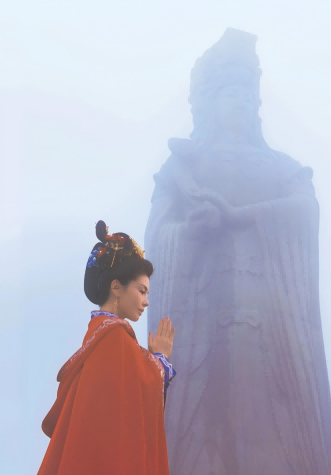
Still of Liu Tao from the television drama Mazu
Against the current historical background, Mazu has emerged with unprecedented cultural appeal as a spiritual bond connecting the Chinese nation. The popularity of Liu Tao's Mazu portrait ultimately stems from the enduring vitality of Mazu culture itself—it is the "spark" of this culture that has transformed a classic screen image into a vivid symbol of cultural communication.
This phenomenon offers meaningful insights for the global outreach of Chinese culture. When traditional cultural elements can generate broad resonance in contemporary society—transcending regional, ethnic, and generational boundaries to become shared spiritual symbols—they possess the potential to evolve into national cultural brands. The path of Chinese cultural brands going global bears striking similarities to the overseas dissemination of Mazu culture. A deep understanding of Mazu's communication patterns and contemporary significance provides valuable lessons for cultural brand building.
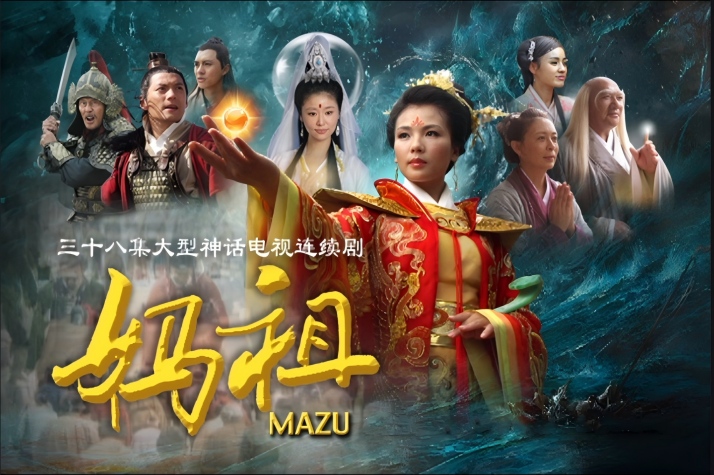
Poster for TV drama Mazu
What Is Mazu Culture? The Core Essence of a Millennium-Old Tradition
Mazu, originally named Lin Mo, was born on the 23rd day of the third lunar month in 960 CE on Meizhou Island in Putian, Fujian Province. According to the historical records, she frequently predicted weather conditions for fishermen, gathered medicinal herbs to treat illnesses without charge, and rescued boats in distress. On the ninth day of the ninth lunar month in 987 CE, she sacrificed her young life while saving people at sea. In remembrance of this kind and selfless young woman, local fishermen built a temple on the island and revered her as a sea deity.
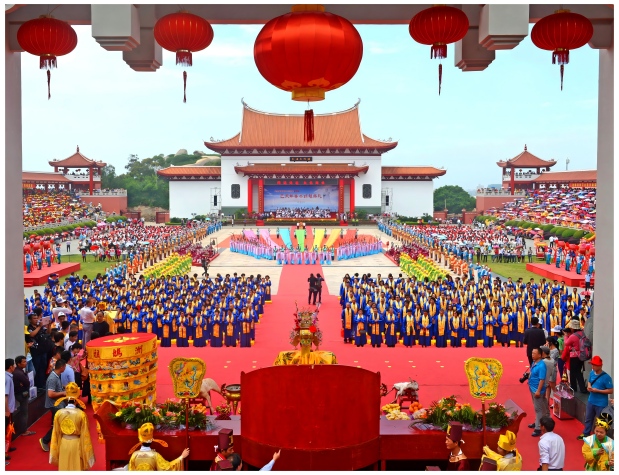
Meizhou Ancestral Mazu Temple in Putian, Fujian (Source: Fujian Provincial Bureau of Cultural Heritage)
Beginning in the late Northern Song Dynasty, Mazu was repeatedly bestowed honorific titles by successive imperial courts—36 in total—for her reputed protection of imperial envoys and maritime transport. Her titles evolved from "Madam" and "Consort" to "Heavenly Consort," and eventually to "Heavenly Empress" and "Holy Mother of Heaven." In 1720 (the 59th year of the Kangxi reign of the Qing Dynasty), Mazu was officially incorporated into the state sacrificial rites of spring and autumn. The Mazu ritual at the Meizhou Ancestral Temple came to be recognized, alongside the Yellow Emperor Mausoleum Ceremony and the Confucian Sacrificial Ceremony, as one of the "Three Great National Ceremonies" of China.
The core spirit of Mazu culture is "cultivating virtue, performing good deeds, and embracing universal love." This ethos incorporates elements of Confucianism, Buddhism, and Taoism. As a folk belief, Mazu culture is inherently inclusive and accessible, strengthening communication and mutual recognition among people of different social strata and cultural backgrounds. Its qualities—benevolence and peace, justice and courage, freedom and diversity, inclusiveness and mutual benefit—resonate strongly with the Silk Road spirit of peace and cooperation, openness and inclusiveness, mutual learning, and win-win development. The charitable spirit embedded in Mazu culture—filial piety, loyalty, righteousness, bravery, and peace—holds universal appeal and inspires people everywhere to pursue goodness and virtue.
In contemporary China, Mazu culture has become an iconic symbol of Chinese cultural identity. In 2009, "Mazu belief and customs" were inscribed on UNESCO's Representative List of the Intangible Cultural Heritage of Humanity, becoming China's first recognized world heritage item in the category of folk belief.
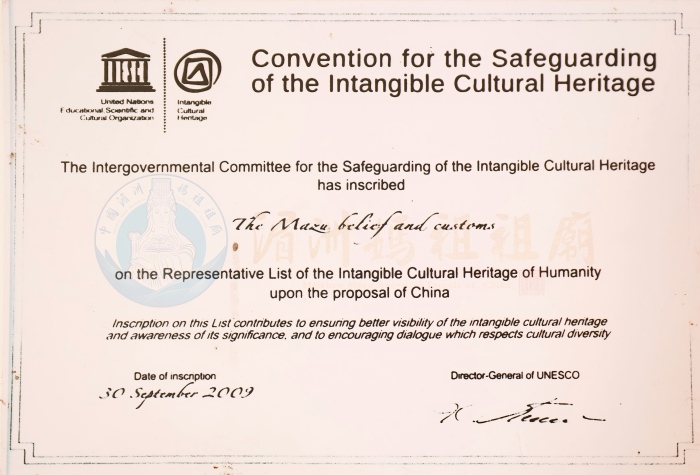
"Mazu Belief and Customs" was inscribed by UNESCO on the Representative List of the Intangible Cultural Heritage of Humanity.
(Source: Official Website of the Meizhou Mazu Ancestral Temple)
The Importance of Mazu Culture: Core Values in the Contemporary Era
In today's context, the significance of Mazu culture lies primarily in strengthening a shared sense of identity within the Chinese nation, fostering emotional bonds among compatriots, and consolidating a shared vision of development among Chinese communities worldwide. On the Chinese Island of Taiwan, for example, Mazu culture carries profound meaning as a spiritual expression of ancestral remembrance and cultural roots. Mazu belief is one of the most widespread folk religions on the Taiwan Island, where more than 3,000 Mazu temples stand across the island and approximately two-thirds of the population revere her. Most of these temples trace their spiritual lineage to the Mazu Ancestral Temple on Meizhou Island in Fujian. Mazu culture represents a vivid example of the deep roots and flourishing branches of Chinese culture on the Taiwan Island. It plays a unique "adhesive" role in promoting grassroots exchanges and advancing integrated development across the Taiwan Strait.
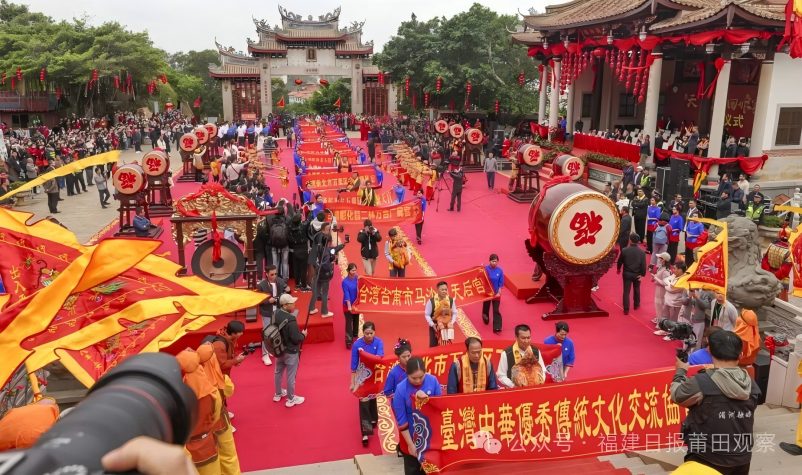
Twenty-nine temples from Taiwan Island participated in the launch ceremony of the "Mazu from Across the World Returning to Her Ancestral Home" event in the Jiachen Year of the traditional Chinese lunar calendar. (Source: Fujian Daily – Putian Observer WeChat Official Account)
For the more than 300 million devotees across over 50 countries and regions worldwide, Mazu temples serve not only as places of worship but also as spiritual homes where overseas Chinese reconnect with their ancestral heritage and cultivate a sense of belonging to their homeland. Mazu culture reinforces collective national identity and gathers spiritual strength from Chinese communities worldwide for the rejuvenation of the Chinese nation.
From a global perspective, Mazu culture also contributes to civilizational exchange and mutual learning, and to the vision of building a community with a shared future for humanity. As the "Goddess of Peace at Sea" Mazu's embodiment of virtue, benevolence, and universal love contrasts sharply with the often aggressive depictions of sea gods in Western mythology, reflecting the peaceful and harmonious essence of Chinese maritime culture. Since its UNESCO recognition in 2009, Mazu belief has become part of humanity's shared spiritual heritage. With its inherent affinity and strong communicative appeal, Mazu culture serves as a "cultural envoy" along the Maritime Silk Road in the new era, contributing positive energy from China to global peace and development.
A Global Communication Landscape: The Overseas Spread of Mazu Culture
Current Status: A Worldwide Network of Faith
Mazu culture has achieved remarkable dissemination among overseas Chinese communities, forming a global network of belief. Today, Mazu worship has spread to more than 50 countries and regions, with over 11,000 Mazu temples and more than 300 million devotees worldwide. The saying" Where there is seawater, there are Chinese; where there are Chinese, there is Mazu" has become a global cultural phenomenon. Even the Portuguese name "Macau" (MACAU) is derived from the pronunciation of "Mazu Pavilion," offering vivid testimony to Mazu culture's overseas influence.
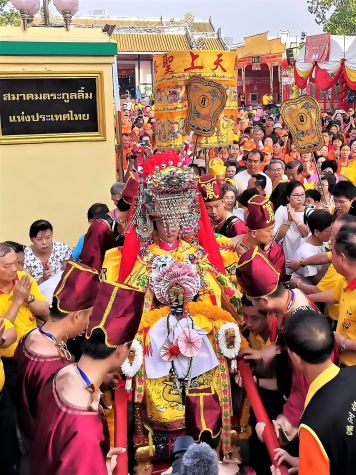
From November 13 to 19, 2019, members of the public in Thailand took part in the Mazu Peace Blessing Tour of the Meizhou Mazu in Thailand. (Source: Putian Release)
Underlying Reasons for Its Global Reach
Why has Mazu culture spread so extensively abroad? Five key factors stand out:
First, migration and the continuity of cultural roots. Mazu belief traveled alongside waves of Chinese migration. During the Ming and Qing dynasties, large numbers of residents from Fujian and Guangdong settled overseas, bringing their faith with them. For migrants, Mazu served as a spiritual link to their homeland.
Second, alignment with maritime protection needs. Mazu is the most influential maritime guardian deity in Chinese culture. As China's maritime activities expanded, Mazu worship spread worldwide. Wherever new ports were established, Mazu temples were often built, allowing her culture to take root locally.
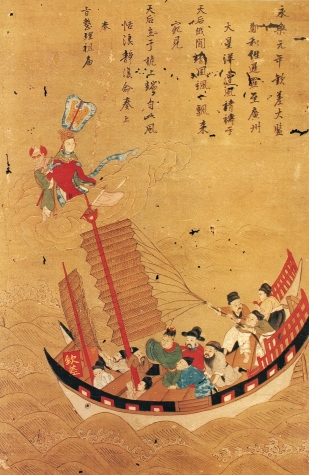
A scene depicted in the Qing Dynasty scroll Illustrations of the Miraculous Deeds of the Heavenly Empress shows Zheng He's fleet on a diplomatic voyage overseas when it is suddenly struck by a storm; the crew kneel to pray to Mazu for protection. (Source: Putian Overseas Chinese Hometown Times Online)
Third, the universality of core values. Mazu's benevolence, compassion for the weak, and spirit of "cultivating virtue, performing good deeds, and embracing universal love" reflect shared human aspirations across cultures and align closely with the vision of building a community with a shared future for humanity.
Fourth, the crucial role of the merchant class. Chinese overseas traders—particularly Fujianese maritime merchants—played a decisive role in spreading Mazu belief. During the Ming and Qing dynasties, ships sailing abroad commonly enshrined Mazu statues, enabling merchants and sailors to worship her throughout their voyages.
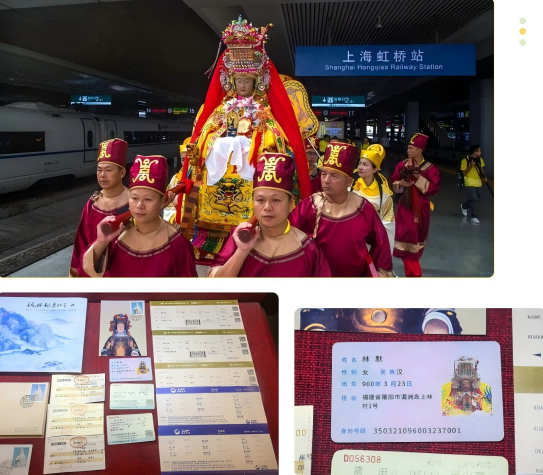
Mazu traveling by high-speed rail, along with the identification card, train tickets, and ferry tickets issued for the journey.
Fifth, innovation in contemporary communication methods. Since 2017, Mazu has undertaken "cross-border pilgrimage tours," traveling by airplane, cruise ship, and high-speed rail to Malaysia, Singapore, the Philippines, Thailand, and beyond, symbolically bringing blessings of peace. Since 2016, the Global Mazu Culture Forum has been held consecutively; its tenth session established sub-venues for the first time in Vietnam, Thailand, Malaysia, Australia, France, Mozambique, Brazil, as well as in Hong Kong, Macao, and Taiwan regions. Digital initiatives—including a global dynamic perception system for Mazu temples and the development of the AI digital avatar "Xiao Mo"—have further opened new opportunities for international communication.
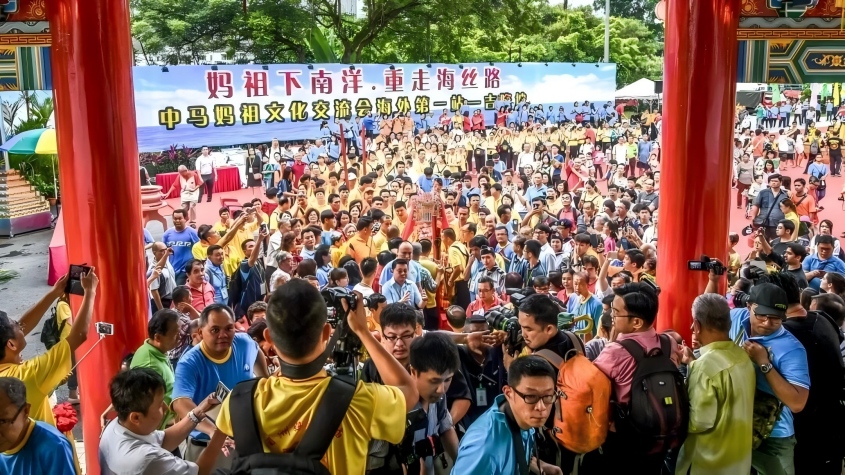
The "Mazu's Journey to Nanyang: Retracing the Maritime Silk Road" delegation arrived in the Philippines and Malaysia
Lessons for Cultural Globalization: Key Strategies from the Mazu Model
The popularity of Liu Tao's "Mazu image" offers several insights for the global outreach of Chinese cultural brands:
Uphold the cultural core and distill universal values. The universality of Mazu's spirit enables resonance across cultures. Cultural outreach must identify and articulate shared human values that transcend cultural barriers.
Respect communication patterns and leverage grassroots support. Mazu culture spread organically through merchant networks rather than solely through official channels. Cultural globalization should empower overseas Chinese communities, civil organizations, and transnational enterprises to serve as bridges.
Innovate communication carriers and cultivate symbolic ambassadors. Liu Tao's portrayal demonstrates the power of effective cultural representation. Selecting public figures who embody Chinese cultural temperament and enjoy international recognition can make abstract cultural values tangible.
Grasp the pulse of the times and respond to real-world needs. Cultural outreach must engage with the social contexts and spiritual needs of target audiences to achieve meaningful resonance.
Integrate tradition and modernity to achieve innovative transformation. From ancestral temple rituals to television dramas and mobile wallpapers, Mazu culture has continuously reinvented itself. Successful cultural outreach must preserve authenticity while embracing modern media.
Strengthen cultural identity in service of national development. Mazu culture's role across the Taiwan Strait highlights how cultural communication reinforces identity and unity. Global outreach should enhance cultural identification among Chinese communities worldwide.
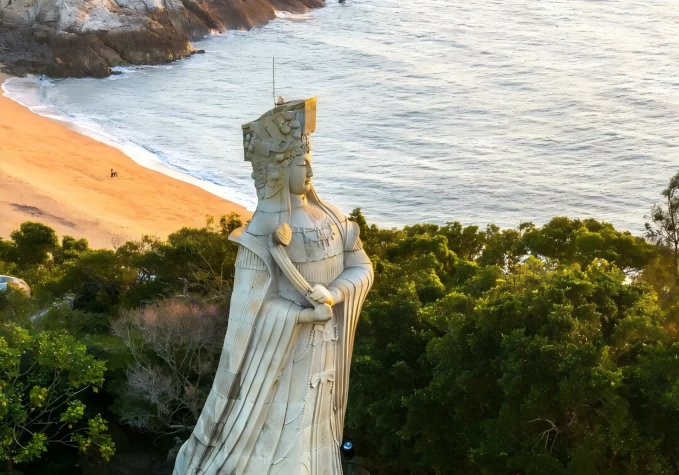
Mazu Statue on Meizhou Island in Putian, Fujian Province
Internal and External Brand Communication: Core Insights from Mazu Culture
Brand communication, both internal and external, should consistently adhere to a principle of differentiation: different audiences require different appeals; different objectives call for different content; different contexts demand different discourses; and different risk environments necessitate different boundaries.
The dissemination of Mazu culture demonstrates a distinct "two sides of one whole" dynamic. Internally, communication emphasizes unity and authority; externally, it highlights flexibility and adaptability. This dual-track experience offers profound insight into how brands can strategically manage the relationship between internal and external communication.
Internal Communication:
On the Chinese mainland, the Meizhou Ancestral Temple serves as the authoritative spiritual source, issuing certificates to branch temples and reinforcing lineage and legitimacy. This unified narrative strengthens believers' sense of belonging. For brands, this suggests maintaining stable core stories, visual systems, and ritualized engagement to foster loyalty.
External Communication:
Overseas dissemination relied on flexible, localized adaptation by merchants and communities. For brands, this underscores the importance of adapting expression and functionality to local contexts.
The Underlying Logic:
Mazu's enduring success lies in distinguishing between the unchanging spiritual core— "cultivating virtue, performing good deeds, and embracing universal love"—and adaptable forms of expression. Brands likewise should clearly define immutable core values while flexibly adjusting peripheral expressions to different markets.
Successful global communication is not one-way broadcasting but a two-way dialogue rooted in self-awareness—requiring both domestic stability and international vitality, unity of core values and diversity of expression.
Conclusion
For over a thousand years, Mazu culture has traveled far beyond Meizhou Island, spreading across the seas. From the ancestral temple to more than 11,000 temples worldwide, from 300 million devoted believers to international recognition as intangible cultural heritage, Mazu culture has become a defining symbol of Chinese cultural identity. The viral popularity of Liu Tao's "Mazu image" is not merely a fleeting online trend—it is an illustration of the success of Mazu culture's transmission, a reflection of spiritual resonance within the Chinese family, and a vivid example of Chinese culture engaging the world.
As Chinese cultural brands venture onto the global stage, they can draw wisdom from the Mazu experience: uphold the cultural core, articulate universal values, respect communication rules, leverage grassroots, innovate media forms, integrate tradition with modernity, strengthen cultural identity, and tell China's story with clarity and confidence.
The "going global" of Chinese cultural brands should draw wisdom from the experience of Mazu culture dissemination: adhere to the cultural core and refine universal values; respect communication laws and make good use of grassroots power; innovate communication platforms and effectively utilize "image ambassadors"; grasp the pulse of the times and respond to real-world needs; integrate tradition and modernity to achieve innovative transformation; base actions on cultural identity and serve the greater good of the nation; maintain distinctions between domestic and international contexts, and tell the Chinese story well. (Author / Wen Yanqing, Editor / Cheng Yingzi)


