On February 12, iQIYI quietly launched its short drama app "DramaSugar" in the Japanese market across both iOS and Android platforms, formally entering Japan's fragmented entertainment consumption space through a subscription-based model. At launch, the platform introduced a full slate of exclusive premium short dramas spanning workplace romance, underdog comebacks, and suspense thrillers.
This move is not an isolated expansion, but rather a reflection of a broader eastward shift among Chinese short drama companies. As the North American market gradually approaches saturation, Japan—backed by a mature culture of paid content consumption and significant growth potential—has emerged as a new blue ocean for overseas expansion. Yet to truly gain a foothold in this promising market, the central question remains: how can short dramas genuinely resonate with Japanese audiences?
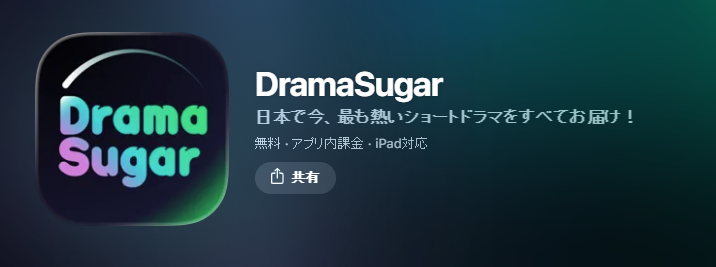
DramaSugar App Store Introduction and Logo
DramaSugar's Localization Strategy in Japan
As a key move in iQIYI's deepening presence in the East Asian market, DramaSugar's rollout reveals a nuanced understanding of and adaptation to the Japanese market. The platform's detailed positioning reflects how Chinese streaming services are recalibrating their strategies for Japan.
On the content front, DramaSugar has built a comprehensive, high-quality library of exclusive titles spanning five core genres. The "Boss Romance · Sweet Indulgence" category centers on contract relationships and forbidden office love, delivering highly immersive romantic fantasies. "Underdog Comeback Stories" focuses on redemption arcs—washed-up protagonists reclaiming success or returning triumphantly to the workplace—tapping directly into viewers' emotional catharsis. The "Urban Modern" section grounds its storytelling in realistic workplace and everyday life scenarios, aligning closely with the lived experiences of Japanese audiences. The "Suspense & Mystery" genre leverages intricate plots and layered twists to challenge viewers intellectually. Meanwhile, "Period Drama · Power and Strategy" blends courtly intrigue with martial chivalry, balancing strong visual aesthetics with narrative depth.
This all-genre strategy not only carries forward the proven thematic strengths of China's short drama industry, but also seeks to address the diverse tastes of Japanese viewers through targeted localization.
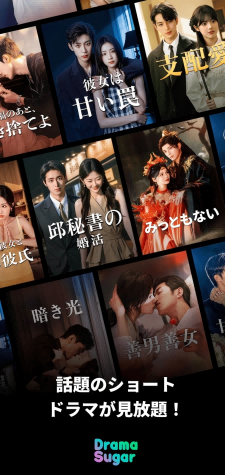
DramaSugar Promotional Page
In terms of product design, DramaSugar is carefully tailored to Japanese user habits. It adopts a clean mode with a minimalist interface and an ad-free environment, ensuring an immersive viewing experience. The app also features automatic watch-history saving and permanent access to purchased titles, while supporting playback speed adjustment and content sharing to lower barriers to engagement. In addition, curated trending charts and a daily update mechanism create an efficient content discovery pathway, enabling high-quality titles to reach users quickly.
Notably, DramaSugar operates on a pure subscription model, without pay-per-episode fees, virtual coin unlocks, or ad-based unlocking mechanisms. It offers two plans: a weekly membership at 2,000 yen (approximately RMB 87.8) and an annual membership at 15,000 yen (approximately RMB 658.5). Members enjoy benefits such as ad-free viewing and priority access to popular dramas. This monetization strategy aligns with Japan's well-established culture of paid content consumption and reflects iQIYI's long-term strategic commitment to the Japanese market—prioritizing subscriber retention and value accumulation over short-term traffic monetization.
According to iQIYI's Q3 2025 financial report, micro dramas have become a major growth driver of its overseas business, with related membership revenue increasing by 140% quarter-over-quarter. In key performance metrics such as membership revenue and total viewing time, micro dramas have already become the second-largest content category after long-form series, laying a solid foundation for DramaSugar's expansion in Japan.
Why Has Japan Become the New Blue Ocean for Short Drama Expansion?
iQIYI's entry is just one example of the growing wave of Chinese short drama companies moving into the Japanese market. In fact, many domestic players had already established a presence in Japan, creating an increasingly competitive landscape. ByteDance launched PikoShow; Jiuzhou Culture introduced ShortMax; and platforms such as DramaBox, TopShort, and MoboReels have all entered Japan, competing directly with local Japanese short drama services.
Looking back at the development trajectory of Chinese short dramas in Japan, the market in the first half of 2024 was still dominated by translated imports. In the second half of the year, however, locally produced Japanese-language originals began to gain momentum. At the end of July, the Japanese short drama Revenge! Cleaning Lady CEO Saki (リベンジ!清掃員CEO・咲), which tells the story of a cleaning worker who is secretly a female CEO, was launched and is estimated to have generated around $3 million in recharge revenue. In October of the same year, The Divorced Granddaughter of a Billionaire (大富豪のバツイチ孫娘), co-produced by TV Asahi and Jiuzhou Culture and adapted from the Chinese short drama After Divorce, I Became the Granddaughter of the World's Richest Man, topped overseas short drama rankings. The show directly propelled ShortMax to No.1 on both the Japanese Google Play and App Store free charts. To date, ShortMax continues to rank No.6 and No.22, respectively, on the entertainment charts of the two app stores.
Meanwhile, DramaBox and ReelShort have also entered the top 20 rankings, signaling that leading Chinese short drama exporters have firmly established themselves in the Japanese market.

Japanese short drama Revenge! Cleaning Lady CEO Saki
The clustering of Chinese short drama companies in Japan is driven by multiple factors. On the one hand, saturation in the North American market has pushed domestic firms to seek new growth opportunities. Li Tao, founder of Xi'an Fengxing Culture, once noted that after testing locally produced short dramas in the U.S. in May 2024, his team found the North American market already relatively saturated, while Japan remained comparatively "untapped." After several months of observation, they decided to shift their focus fully to Japan. Nan Yapeng, General Manager of the Beijing-based company behind ReelShort, also pointed out that the European and American markets are crowded with leading players and marked by intense competition, whereas culturally closer markets such as Japan and South Korea offer higher success rates for small- and medium-sized entrants.
On the other hand, Japan's own market advantages are highly attractive. As one of the world's most important content consumption markets, Japan has a mature base of paying users. According to data from the overseas internet services platform Diandian, from August 2023 to June 2024, Japan's short drama market generated $13.22 million in revenue with over 3.2 million downloads, achieving an average revenue per download (RPD) of approximately $4.13. By 2025, Japan had firmly become the second-largest overseas short drama market after the United States, with revenues exceeding $70 million. For the full year 2025, the market recorded more than 20 million downloads and generated over $160 million in revenue, with RPD surpassing $7—further highlighting its strong purchasing power and mature content consumption habits.
More importantly, China and Japan share an East Asian cultural heritage, making content adaptation comparatively smoother. Unlike in Western markets, where themes such as werewolves or vampires often need to be incorporated to resonate with audiences, many proven hit scripts from China can transition more "seamlessly" into the Japanese market after localization, without drastic genre shifts.
Current State and Pain Points of Japan's Short Drama Market
However, as more Chinese companies continue to enter and Japanese local players gradually step in, competition in Japan's short drama market has intensified, and both its current development stage and underlying pain points have become increasingly clear.
From a market development perspective, Japan's short drama sector is still in an early growth phase, characterized by a structure in which Chinese companies take the lead while local players are just getting started. Mitsukuni Kim, CEO of HeYa Culture, drawing on his team's experience producing 30 short dramas and creating the hit The Divorced Granddaughter of a Billionaire, has offered insights into the current landscape. He points out that Japanese local producers remain at an early stage in their short drama deployment and have yet to fully grasp the logic of the format. The core issue lies in the fact that their production environment and institutional systems have not yet adapted to the short drama model. Instead, they are still operating within the framework of traditional long-form drama production, which directly results in relatively high production costs for locally produced short dramas.
Data shows that even producing two to three hundred domestic dramas per year is considered a solid output level in Japan, averaging around 20 per month. Meanwhile, starting in May 2025, demand from Chinese companies for filming short dramas in Japan declined significantly. The key reason was the lack of new breakout hits to sustain market confidence. Since The Divorced Granddaughter of a Billionaire became a hit in October 2024, no subsequent production has reached a comparable level of success. Although some titles have outperformed dubbed imports, they have not met the expectations set for platform-backed original productions. As a result, major companies have become more cautious, slowing down their production plans.
That said, it is worth noting that Japanese television stations and local platforms tend to adopt a more gradual and methodical approach to market expansion. After demand from Chinese platforms decreased, many production teams began shifting toward collaborations with Japanese local partners. Orders from Japanese TV stations and domestic platforms have correspondingly increased, signaling a structural adjustment rather than a full market contraction.

Japanese short drama The Divorced Granddaughter of a Billionaire
At the audience level, Mitsukuni Kim notes that the primary viewers of short dramas in Japan are women aged roughly 20 to 40, accounting for more than half of the total audience and slightly exceeding male viewership. Interestingly, during the paid traffic acquisition stage, algorithm-driven recommendations tend to reach a higher proportion of male users. However, once users move into actual viewing, female audiences demonstrate stronger retention rates and higher payment conversion. This indicates that female-oriented content holds greater competitive potential in the Japanese market—closely mirroring the audience profile of Japan's mobile vertical-comic (webtoon) sector.
In addition, according to Fengxing Culture founder Li Tao, Japanese audiences are not unfamiliar with Chinese cultural content. Female viewers show strong interest in ancient romance web novels and historical costume dramas, while male viewers are enthusiastic about Chinese wuxia and "miracle doctor" themes—stories featuring dramatic martial arts techniques and glowing special effects that miraculously heal characters, elements they particularly enjoy and even imitate. This cultural affinity provides a natural advantage for the localized adaptation of Chinese short dramas in the Japanese market.
At the industry chain level, Japanese short dramas still have numerous areas for improvement, yet they also present entry opportunities for domestic producers. Regarding actors, remuneration for Japanese short drama performers is projected to rise by 2025 as more accomplished traditional long-form drama actors enter the short drama sector. However, the industry has yet to cultivate a dedicated pool of seasoned actors specializing in short dramas. Compensation standards remain largely determined by actors' credentials in long-form productions. Actor costs account for approximately 30% of a short drama's total budget, maintaining relative stability without the price hikes seen when domestic actors gain popularity. Regarding production teams, Japanese short drama producers primarily fall into two categories: Chinese teams and Japanese teams. Japanese teams mainly handle projects for domestic platforms, while Chinese teams focus on projects for Chinese platforms. Only 3 to 5 Chinese teams can consistently deliver projects. Some smaller Chinese teams face issues like production delays and cost overruns due to a lack of Japanese production resources. Japanese teams, however, may fail to grasp the unique characteristics of short dramas. Over-reliance on them can lead to subpar results, representing two common pitfalls for Chinese producers filming in Japan. Regarding IP adaptations, despite Japan's abundant novel and manga IP resources, such adaptations currently constitute a small proportion of short drama scripts. The core reasons include Japanese rights holders' stringent copyright demands, high communication costs, and lack of experience in licensing short dramas. They still approach short drama collaborations through traditional film and television logic, hindering the development of IP-adapted short dramas.
How to Truly Resonate with Japanese Audiences?
Based on the market analysis and industry practices as mentioned above, to truly resonate with Japanese audiences and establish a foothold in Japan's short drama market, domestic producers must move beyond the mindset of "simply replicating domestic models." They need to achieve deep localization across three dimensions—content, production, and operations—while balancing their own strengths with the unique characteristics of the Japanese market.
At the content level, it must precisely align with Japanese audiences' emotional needs and genre preferences, achieving a fusion of "Chinese catharsis + Japanese context." On one hand, we should leverage the "feel-good" strengths of domestic short dramas, focusing on core themes like overcoming adversity, sweet pampering, and suspenseful mysteries. Japanese women face high-pressure workplace cultures and lower social status, making gender-swapped feel-good dramas—such as "a contemporary Japanese career woman time-traveling to ancient China for revenge and redemption"—perfectly tailored to fulfill their emotional needs. For male audiences, wuxia and divine physician genres can preserve Chinese cultural elements while adapting to Japanese aesthetic preferences through optimized pacing and visual presentation. On the other hand, accelerate IP adaptation exploration by leveraging Japan's rich manga and novel IP resources. Collaborate with local IP holders to reduce copyright negotiation costs while avoiding the pitfall of "condensing long-form dramas into short formats." Instead, create works that genuinely align with the logic of short dramas.
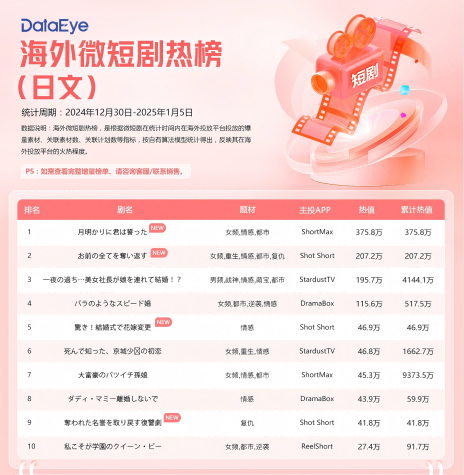
DataEye Overseas Micro Drama Hot List
At the production level, a "China-Japan collaborative" team model must be established to balance professionalism with localization. Fengxing Culture's approach offers a viable path: combining Japanese local actors with a seasoned Chinese production team. The Japanese team serves as external support, handling actor communication, location submissions, and other localization tasks, while the Chinese team controls core elements like pacing and thrill-inducing design. This ensures both the content's "thrill factor" and the localization of language, settings, and performances. Simultaneously, pitfalls in collaboration must be avoided. Rather than blindly relying on small Chinese-Japanese teams or solely Japanese teams, partners with proven experience and robust resources should be selected. When necessary, following Heya Culture's approach of employing Japanese directors and crews throughout production can deeply integrate the strengths of Chinese short dramas with Japan's production resources. Additionally, production costs must be managed. A single Japanese short drama typically costs around $100,000 to $120,000 to shoot over 7 to 8 days—higher than domestic Chinese short dramas but significantly lower than Western markets. Producers should optimize cost structures by allocating resources efficiently across actors, sets, and other elements.
At the operational level, it is essential to adapt to Japanese users' usage habits and payment models to build an ecosystem that fosters long-term retention. In product design, DramaSugar's minimalist interface, ad-free environment, and viewing progress saving features should be retained to align with Japanese users' demand for immersive experiences. For monetization, leveraging Japan's established paid content foundation, subscription models or reasonable paywall points should be adopted to avoid excessive commercialization impacting user experience. Additionally, drawing from domestic short drama operations, content recommendation mechanisms like charts and genre-specific features can guide users to discover quality content. Furthermore, brand cultivation is crucial. By consistently producing high-quality content and executing localized marketing campaigns, the industry can dismantle the traditional Japanese entertainment industry's "contempt chain" toward short dramas. Mitsukuni Kim noted that by 2025, major Japanese platforms and broadcasters have gradually shifted their stance, moving beyond viewing short dramas as "lowbrow." This shift creates a favorable environment for domestic companies to build their brands.
Notably, manga dramas may emerge as a new breakthrough to captivate Japanese audiences. As a major player in the anime industry, Japan boasts a vast market but lags in the technological application of mobile manga dramas. China, however, holds advantages in the technological iteration and production efficiency of micro dramas and manga dramas, creating potential for mutual complementarity. As a fusion of comics and short dramas, manga dramas can leverage Japan's rich comic IP resources while catering to users' fragmented viewing habits. Combined with AI-driven production efficiency, they are poised to become a new growth driver in Japan's short drama market, offering domestic producers a path for differentiated competition.
Summary and Outlook
From the low-profile launch of iQIYI's DramaSugar to the collective expansion of major Chinese platforms, and the gradual entry of Japanese domestic players, the "Japan wave" in short drama globalization has become increasingly evident. Data from Omdia indicates that the global expansion of short dramas is an irreversible trend. As the second-largest overseas short-drama market, Japan offers a mature paid-user base, significant growth potential, and strong cultural resonance with China—making it a crucial battleground for Chinese companies seeking a second wave of growth.
Yet behind these opportunities lie multiple challenges, including cultural differences, intensifying competition, and an underdeveloped industry chain. Simply replicating the domestic model will not ensure long-term success. Only by truly understanding Japanese audience preferences and achieving deep localization across content, production, and operations can Chinese short-drama companies hope to stand out and secure a sustainable foothold in this emerging blue ocean market.
For Chinese domestic short drama companies, the Japanese market may indeed resemble what Li Tao described as "China's market in early 2022"— full of both opportunity and uncertainty. Whether iQIYI can leverage its mature content production capabilities and membership operation experience to break through the competition, whether teams such as Heya Culture can successfully carve out a new path through their manga drama strategies, and whether Chinese producers can truly overcome cultural barriers and resonate with Japanese audiences will not only determine the success of their individual overseas expansions, but also shape the broader trajectory of China's short drama globalization. (Author / Li Sixuan, Editor / Cheng Yingzi)


