The 68th Grammy Awards were held on February 1, 2026 (local time) in Los Angeles, once again drawing the global music industry's attention to the extraordinary creative power of human artists. Yet behind this celebrated event, a deeper industry consensus is quietly reshaping the rules of the content business. As early as April 2025, after in-depth discussions between the Recording Academy and the U.S. Copyright Office, a clear statement was made: "Copyright exists for human subjects and creators—not for artificial intelligence." This principled stance acts like a spotlight, laying bare the copyright dilemma surrounding AI-generated content.

A Robot Musician
China's micro-short drama industry is currently expanding overseas at an astonishing pace. By the end of 2025, the market size had surpassed RMB 50 billion, with a user base of 664 million. More than 300 Chinese micro-short drama apps have already launched on overseas platforms. At the same time, Chinese IP-based works such as the game Black Myth: Wukong and the film Nezha 2 have gone viral both domestically and internationally, highlighting the global appeal of traditional Chinese culture. Since 2025, a wave of high-quality micro-short dramas incorporating Chinese cultural elements—such as intangible cultural heritage (ICH), regional traditions, and historical narratives—has continued to emerge.
AI technology is also profoundly reshaping production workflows in the micro-short drama sector. For example, the micro-short drama The Monkey King consists of 10 episodes totaling 60 minutes, all generated entirely by AI. In 2025, China's AI comic and animation industry also experienced explosive growth. Riding this AI-driven momentum, Chinese culture is accelerating its global reach, with micro-short dramas becoming a key vehicle for China's cultural "going global" and viral breakout.

Mariah Carey, five-time Grammy Award winner
However, the industry now faces new challenges such as "AI-powered infringement." On one hand, the principle of "human creativity first" remains clear; on the other, while AI tools offer higher efficiency and lower costs, they also introduce legal risks. For Chinese micro-short drama companies expanding overseas, this blue ocean of traffic dividends is riddled with hidden reefs—particularly music copyright risks. As a cultural export industry, how can micro-short dramas navigate through the fog of AI copyright and find a safe course forward?
Into Deep Waters: Three Major AI Music Copyright Risks for Micro-Short Dramas Going Global
When it comes to AI music copyright, micro-short drama exporters are navigating a complex legal and technological sea, facing three unavoidable risks.
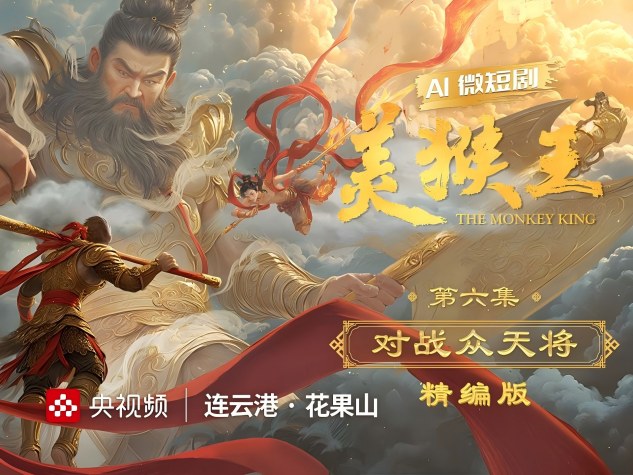
Poster for The Monkey King
The first risk stems from the fragmentation of global AI copyright standards. With no unified international framework for determining copyright ownership of AI-generated content—and with national rules often conflicting—companies face complex legal uncertainties. For instance, the United States emphasizes substantial human authorship, while the EU and other regions apply differing standards, creating a patchwork of regulations that significantly increases global compliance costs. Meanwhile, the growing consensus represented by institutions such as the U.S. Copyright Office and major awards bodies—centered on "human creation"—fundamentally questions whether purely AI-generated music can qualify as protected works, undermining its legal basis for commercial use.
Notably, some pragmatic industry experiments have begun to offer partial solutions. In September 2025, the Swedish Performing Rights Society (STIM) reached a landmark agreement with generative AI company Songfox, signing the world's first copyright licensing framework for AI model training. This agreement establishes a lawful pathway allowing Songfox to train AI models on copyrighted music with authorization, while ensuring that songwriters and composers receive appropriate compensation. It represents a practical attempt to balance legal uncertainty with industry realities.
The second risk, even more challenging than fragmented legal rules, lies in technical ambiguity. When AI "learns" from existing works and generates new music, the boundary of "substantial similarity" with copyrighted originals is notoriously difficult to define. Is it legitimate stylistic inspiration, or unlawful expression copying? China's Domestic court rulings on AI text-to-image cases suggest that judicial decisions often hinge on case-by-case evaluations of "human involvement," such as prompt design, parameter adjustments, and post-editing. Once faced with an infringement claim, overseas-facing companies often struggle to fully prove the compliance of their AI music generation processes, leaving them in a reactive and vulnerable position.
The third risk arises from the tension between enforcement costs and business efficiency. The Copyright Administration under the Publicity Department of the Central Committee of the Communist Party of China has noted that micro-short dramas going overseas often face difficulties such as "inefficient copyright transactions and challenges in overseas rights enforcement." If embroiled in foreign infringement litigation, companies may face prolonged legal proceedings, substantial damages, and immeasurable reputational losses. Such high-risk exposure fundamentally conflicts with the micro-short drama industry's low-cost, fast-turnover business model, making any copyright misstep a potential "Achilles' heel" capable of derailing an entire project.
Strategic Rethinking: Finding a New Course Between Compliance Constraints and Efficiency Temptations
In light of these challenges, simply calling for "stricter review" or "obtaining licenses" is unlikely to match the industry's real-world speed and cost structure. Micro-short drama exports require a deeper strategic shift—from passive risk control to proactive value reconstruction.
A change in mindset may be the key. Viewing music copyright merely as a cost to be minimized is no longer viable. A more forward-looking approach treats it as a strategic investment in content differentiation and brand value. A compelling example is An Encounter with Liang Chenyu, China's first "Kunqu Opera + cultural tourism" ICH short drama, showcased during a roadshow in September 2025. Rather than wandering through the copyright maze of AI music, the project integrated its narrative core with music drawn from well-documented, deeply rooted intangible cultural heritage. By collaborating with authoritative institutions and ensuring clear authorization from the source, the project not only effectively mitigated infringement risks but also built strong cultural recognition and premium value in overseas markets—creating a differentiation advantage that is difficult to replicate. From this perspective, music is no longer interchangeable background material, but the inseparable soul of the content itself.
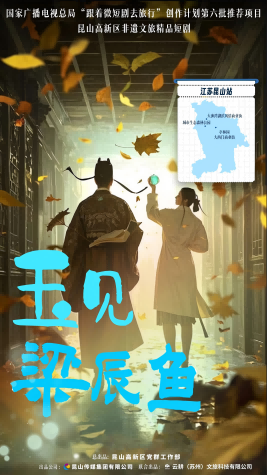
Poster for An Encounter with Liang Chenyu
From an operational standpoint, differentiated content strategies are essential. Different types of micro-short dramas require different copyright solutions. For mass-produced, fast-turnover content, companies should strictly use royalty-free music libraries with clear global commercial licenses, eliminating infringement risks at the source. For premium, brand-building productions, it is necessary to invest in custom compositions, direct collaboration with rights holders, or deep integration with ICH and other cultural elements—allowing music to transcend its functional role and become a core component of IP value.
Technology itself can also support compliance. AI's role in music should not be limited to generation alone, but extended to rights management—such as using audio fingerprinting to screen for infringement before release, or leveraging blockchain to record and trace legitimate music usage. In this way, technology shifts from being a source of risk to a protective barrier for global distribution.
Under the principle of "proactive construction rather than passive response," music copyright considerations must be embedded at the project's earliest stages—clarifying sourcing paths (bulk licensing, custom creation, or ICH integration) and evaluating legal clarity and budget feasibility in target markets. Contracts must function as genuine "risk firewalls," with full rights warranties and indemnification clauses to transfer potential liability to music providers. Finally, companies should establish systematic emergency response mechanisms, enabling them to quickly produce complete evidence chains—such as licenses and payment records—within legal deadlines, preventing losses from escalating due to delayed or improper responses.
Conclusion: Sailing Toward Certainty
While AI-generated music may one day enter the halls of the Grammys, its unresolved copyright ownership issues have already become an unavoidable reality for industries such as micro-short dramas. The grand narrative of micro-short dramas going global cannot rest on wishful thinking about copyright risks. At its core, the AI music copyright dilemma reflects a broader misalignment between rapid industrial growth and foundational legal frameworks.
This strategic shift opens a more sustainable and meaningful path for cultural exports. When music, visual art, and storytelling are deeply fused with intangible cultural heritage and regional traditions, content transcends pure consumption and becomes a tangible, resonant cultural carrier. Such culturally distinctive works not only avoid homogenized competition, but also foster emotional connections with overseas audiences—enabling a leap from "traffic acquisition" to genuine "cultural identification."
When companies stop viewing copyright as a nuisance to be avoided and begin treating it as a strategic anchor for brand building and cultural value accumulation, their course becomes clear. Ultimately, those who gain a firm foothold and lasting respect in global markets will be creators who respect the rules, leverage culture wisely, and build their own content moats with professionalism. This is not only commercial success, but the concrete realization of cultural influence on the global stage.


