Recently, P&G Studios under Procter & Gamble, together with the group's natural personal care brand Native and Dentsu Entertainment, announced the production of a 50-episode vertical-format micro drama titled The Golden Pear Affair, with its trailer scheduled for release in January 2026. The project is not only a new experiment by Native in the field of content marketing, but is also widely regarded as the first long-form, brand-co-produced micro drama in the U.S. market specifically designed for the vertical-screen ecosystem. Procter & Gamble's narrative role shift through P&G Studios further reflects the deeper impact that micro dramas are having on brand storytelling.
As a leading player in the consumer goods industry, P&G's move—anchored in its strategic deployment via P&G Studios—represents both an iteration and an upgrade of its brand content narrative system. More importantly, it signals that micro dramas are evolving from a marginal marketing tool into a potential core medium capable of supporting long-term brand strategy and reshaping narrative logic. Behind this transformation lies the systemic reconfiguration of brand storytelling driven by micro dramas, offering a valuable reference for brands across industries as they explore new pathways in content marketing.

P&G's vertical micro drama The Golden Pear Affair
Low-Barrier Entry: Sponsorship & Shallow Integration
For most brands, sponsorship and shallow integration are often the initial steps into the micro drama realm. With their low barriers and high flexibility, these methods have become a go-to approach for brands exploring new media channels. In this model, the brand typically participates as a sponsor, focusing on basic exposure and brand recognition rather than controlling the storyline, and aims to leverage the micro dramas' audience reach for efficient engagement.
P&G's brands have previously experimented with series marketing in China. As early as 2010, Rejoice launched the custom series Silk Heartbeat, produced by Hunan TV. In May 2024, the micro drama The Unique Her, sponsored by Safeguard, was released, with the brand's logo prominently displayed on the series' cover for simple and direct exposure. In January 2025, OLAY's custom micro drama Put Up Sour and Sweet debuted, which, although custom content, still falls under the category of "brand-sponsored content." The storyline was primarily designed with audience preferences in mind, with the brand appearing more as a background element, without deeply integrating into the narrative structure. This lightweight model is suitable for brands in the early stages of exploring micro drama' audience fit, as it requires minimal investment in content systems and allows for quick media testing and market feedback collection.

OLAY's custom micro drama Put Up Sour and Sweet
Moderate Integration Model: "Content as Marketing"
As brands gain experience in micro drama operations, they often shift toward a moderate integration model, where the product, brand philosophy, and storyline are deeply intertwined. This approach moves beyond mere exposure, aiming for a "content as marketing" effect. In this model, the brand is no longer just a passive advertising medium; it becomes a key element driving the plot forward. Through scene-based presentations, the brand's value is conveyed, enhancing user acceptance and trust.
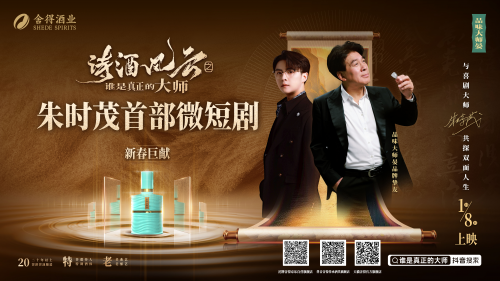
Micro drama produced by Shede Spirit: Poetry and Wine: Who Is the True Master?
Beauty and spirits brands have been particularly active in this model. According to The 2024 Social Media Marketing Trends Report for the Liquor Industry released by Weiboyi, alcoholic beverages rank among the top five industries in terms of brand collaborations with micro dramas. Unlike traditional film and TV advertising—such as pre-rolls, end credits, or overt product placement—micro dramas often weave brand culture and historical heritage directly into narrative details to achieve a "content-as-marketing" effect.
For example, Yanghe Co. previously launched the micro drama The Master Talks About Mellow Smoothness, which combines lighthearted storytelling with accessible explanations to introduce audiences to Yanghe's signature mellow-style baijiu. Scenes featuring the spirit design center, clay jar cellars, and fermentation rooms were all shot on location at Yanghe's distillery. In January 2025, Shede Spirit collaborated with its Master Taster Yan and comedian Zhu Shimao on Poetry and Wine: Who Is the True Master? Framed around the time-travel journey of Tang dynasty literary figure Chen Zi'ang, the drama uses Yan's mastery of time-honored brewing techniques as its narrative, aiming to paint a humanistic tableau that bridges history and modernity.
Similarly, Maybelline's 2025 Christmas campaign Maybe This Christmas employed a micro drama format to embed products deeply within the plot. In these cases, the micro drama structure functions not merely as a storytelling vehicle, but as a core space for conveying brand values—allowing product strengths to emerge organically through narrative progression and reducing the audience resistance often associated with overt advertising.

Maybelline's 2025 Christmas campaign Maybe This Christmas employed a micro drama format
Deep Integration Model: Brand-Led Narrative & Long-Term IP Building
A small number of brands with strong content foundations and robust resource-integration capabilities may opt for a deep-integration model. In this approach, brands gradually evolve from mere financiers into content orchestrators and narrative architects—taking the lead in the creation, distribution, and long-term value accumulation of mini series. Micro dramas are thus incorporated into a brand's long-term content strategy, with the goal of building a sustainable and reusable brand universe. This model places high demands on a brand's content control, investment capacity, and long-term operational patience, but when executed well, it can form a highly defensible competitive moat that is difficult to replicate.
P&G's production of The Golden Pear Affair can be seen as a representative case of deep brand integration into micro dramas. Leveraging the professional production capabilities and strategic coordination of P&G Studios, P&G seeks to move beyond the traditional role of a behind-the-scenes sponsor and instead become the primary driver of narrative creation. The brand is deeply involved throughout the entire process—from story design and value articulation to distribution strategy.
Structured around dual storylines of adventure and romance, the drama avoids simplistic product placement. Instead, it tightly weaves Native's fragrance products into character arcs and plot turning points, allowing product attributes to align with characters' destinies and narrative progression. Through this approach, the drama organically communicates the core idea that consumers deserve high-quality service and trustworthy clean products, breaking away from the conventional marketing logic that focuses narrowly on functional claims.
In terms of rollout, the trailer is scheduled for release in January 2026, with the full series set to debut first on major North American social platforms to capture public-domain traffic. Subsequent distribution may extend to P&G's own apps to facilitate private-domain retention, aiming to build a closed-loop user relationship model of "reach-engagement-retention" and achieve an upgrade from short-term exposure to long-term brand attachment.

P&G's official website
Meanwhile, as the core pillar of P&G's proprietary content ecosystem, P&G Studios has, since its inception, been tasked with integrating brand values into diverse content formats. Its move into micro drama can be seen as a strategic extension of this mandate in the era of mobile internet and vertical-screen consumption.
Rather than pursuing a short-term, traffic-harvesting approach based on superficial placement, P&G has positioned itself as a narrative leader—seeking to incorporate micro drama into its long-term brand content asset system. This strategy not only enables the Native brand to break into new audience segments with greater precision, but also reinforces overall brand recognition across the P&G portfolio through consistent and unified value storytelling.
This deep strategic shift is not a temporary decision but rather an extension and innovation of P&G's nearly century-old narrative DNA in the age of new media. As early as the 1920s, P&G pioneered the rise of American "soap operas," using a model of "brand sponsorship + serialized storytelling" to deeply integrate household products with family narratives. This made P&G one of the key pioneers of content marketing at the time.
As media evolved from radio to television and now to mobile vertical screens, P&G's content strategy has continuously adapted. From early sponsorship collaborations to the establishment of P&G Studios for systematic content creation, and now to its leadership in micro drama production, the core logic likely revolves around "using stories to convey value."
The emergence of micro dramas perfectly aligns with the current fragmented consumption habits and emotional value demands of users. It presents P&G with the opportunity to translate its century-old narrative expertise into a new medium. This could potentially transform micro dramas into a sustainable storytelling ecosystem, rather than limiting them to one-time marketing campaigns. This keen understanding of media trends and the focus on long-term content assets could be one of the core values micro dramas bring to brand storytelling—helping brands break through the limitations of media cycles and achieve value accumulation across generations.

P&G Studios under Procter & Gamble
Key Takeaways: Differentiated Paths, Shared Logic
The core insight into brand involvement in micro dramas lies in the underlying logic of adapting their strategy to the media characteristics. Essentially, this can be summarized as "user-centric, value-driven." A light entry is suitable for early exploration and quick exposure, while a moderate integration helps reinforce brand recognition and core value communication. A deeper investment is more appropriate for building long-term brand assets and establishing competitive barriers. No path is inherently superior; the key lies in the brand's resources and strategic objectives.
From an industry practice perspective, micro dramas appear to be gradually shedding their "niche entertainment" label and evolving into a foundational infrastructure worthy of attention in brand storytelling. Their reshaping of brand content narratives can be reflected across multiple dimensions. First, they reconstruct narrative scenarios, helping brands shift from the "hard product placement" of traditional advertising to a more "soft integration" within the storyline, which is likely to reduce user resistance. Second, they broaden the narrative cycle, breaking the time constraints of one-off marketing campaigns and forming extendable, reusable content assets. Third, they upgrade the narrative subject, transforming brands from "information issuers" into "storytellers," thereby strengthening emotional connection with users.
However, micro dramas are not a universal marketing solution. The reason why P&G's attempt has attracted attention is likely because it has a clear and stable brand value core, a century-long experience in content operations, and the professional support provided by P&G Studios—not merely because of the micro drama format itself.
In the future, as the micro drama industry continues to mature, brands will likely see more differentiation in their approaches. Narrative innovation, value transmission, and user engagement may become key competitive points. Brands that can leverage their unique characteristics and focus on content quality are likely to maximize their narrative value in the micro drama space, allowing micro dramas to truly become a bridge for communication between brands and users, and to build sustainable brand competitiveness.


