In early 2026, the AI comic drama sector saw a series of major signals: China Media Group (CMG) officially announced two national-level initiatives—the China AI Comic Drama Conference and the CMG First China AI Comic Drama Night—setting a clear directional benchmark for the industry. Meanwhile, ByteDance announced that daily spending in its comic drama segment had peaked at over RMB 30 million, while Shuqi Chinese Web novel revealed investments exceeding RMB 100 million to fully scale AI comic dramas across the entire production chain. From "one-person teams" launching accounts in seven days with the help of tools like OiiOii, to platform giants building industrialized pipelines, a technology-driven comic drama revolution is moving beyond its initial phase of wild, disorderly growth. As output surges from 38,000 titles in 2025 to a projected 100,000, the industry's euphoria masks a harsher reality: a deep shakeout that will determine survival or extinction is imminent, and as many as 90% of players may be forced out. Against this backdrop, as AI comic dramas move from wild growth into an era defined by a "battle of standards," and as the industry faces an oncoming tsunami of production capacity and fierce consolidation, what kind of players will be able to build a true moat—and survive?
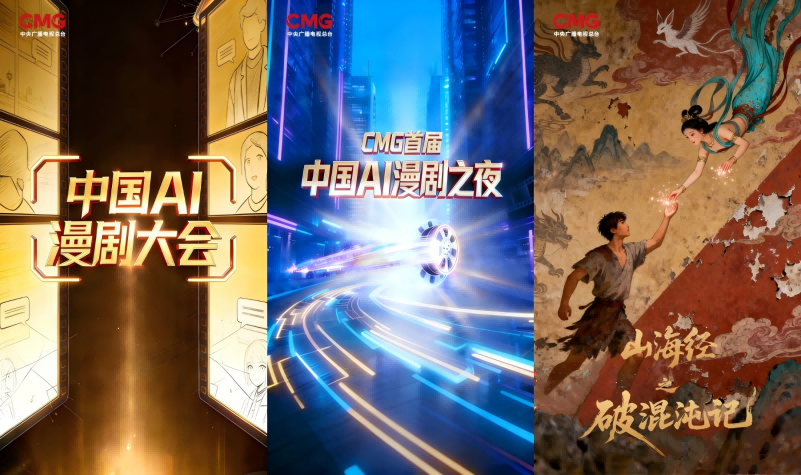
China Media Group (CMG) announced the China AI Comic Drama Conference and the CMG First China AI Comic Drama Night
The Cost Revolution: The Underlying Logic Behind Market Explosion
In 2025, China's AI comic drama industry experienced explosive growth. More than 47,000 works were released throughout the year, market size surged twelvefold year-on-year, and monthly views surpassed the 10-billion mark. Data from Kuaishou shows that daily revenue from AI comic dramas in Q3 2025 increased by 900% compared with Q4 of the previous year, while monthly output rose by 567%.
The core driver of this growth lies in a fundamental transformation of the cost structure. Traditional comic dramas typically cost RMB 2,000–5,000 per minute to produce; with AI integration, this can be reduced to RMB 1,000–2,500—a cut of up to 50%. AI has deeply penetrated the entire workflow, from scriptwriting and storyboarding to motion generation and voice acting, improving efficiency by 50–80% in some stages.
Industry producers reveal: "A premium comic drama of around 35 episodes, each about seven minutes long, used to require nearly nine months and a total budget exceeding RMB 1 million. With AI assistance, the production cycle can be shortened to four months, with costs kept under RMB 500,000."
This cost revolution quickly drew players from across the ecosystem. Leading platforms such as Yuewen, Douyin, and Shuqi rolled out support programs, while production companies like Small Design and Qixiang Culture ramped up monthly output from just a few titles at the beginning of the year to dozens by year's end. AI tools aimed at a broader creator base further democratized productivity. Taking OiiOii as an example, its official estimates show that during promotional periods, producing one minute of animation can cost as little as RMB 10. This has made commercial creation by "one-person teams" or small studios viable, directly giving rise to large numbers of creators on Xiaohongshu and Kuaishou who use AI animation to rapidly launch accounts—some achieving viral success within seven days, with hit rates exceeding 30%.
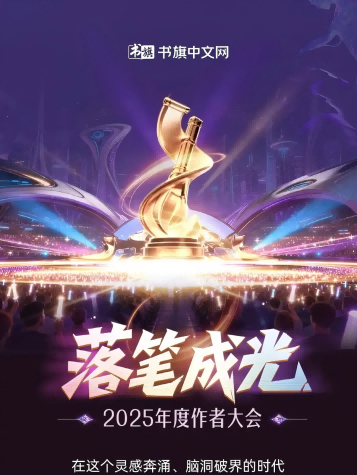
Shuqi Chinese Web novel 2025 Annual Creators Conference
Workflow Reengineering: From Tool Use to Intelligent Collaboration
AI's penetration into comic drama production has evolved from auxiliary tools to full workflow restructuring. In early 2025, AI was mainly used to generate single character images or background art; by the second half of the year, it had become deeply involved in the entire production pipeline.
Li Yuan, founder of Qixiang Culture, shared this shift: "AI technology itself is iterating faster and faster, and models are becoming increasingly adept at stylized expression. Previously, we needed to train character consistency models and constrain keyframes; now, just 3–9 images can generate near frame-by-frame effects."
A typical AI comic drama workflow is now fully digital. A 400,000-word novel can be imported into an AI script-generation tool, then refined by a comic drama editor to produce 12 commercially viable episodes within a single day. Character design—one of the most critical stages—previously required nearly two months of manual drawing. With AI tools, the lead artist needs only to sketch a single character concept, add style classification models as needed, and import static and dynamic pose libraries to generate a full training dataset for character models.
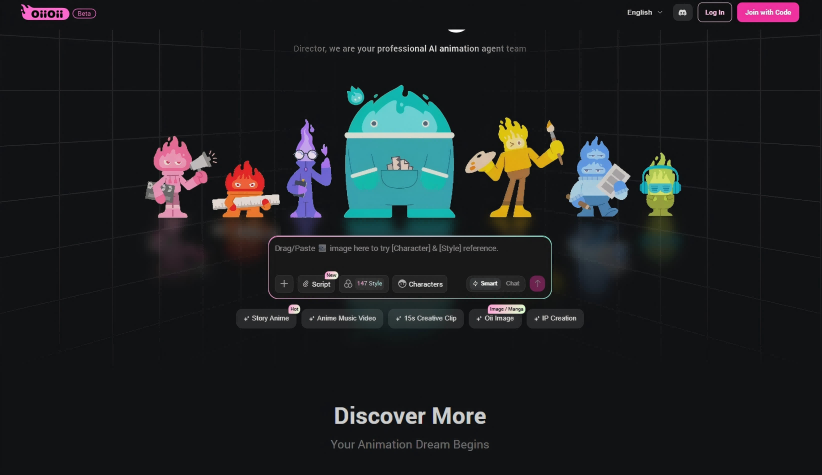
Website of OiiOii
This evolution is moving toward an even more intelligent stage. New-generation tools like OiiOii no longer optimize individual steps but enable agent-based collaboration across the entire pipeline. They encapsulate professional animation roles—art director, screenwriter, storyboard artist, and more—into seven AI Agents capable of natural dialogue. As a result, users undergo a fundamental role shift: from "technical operators" who must master prompt engineering to "directors" or "creative decision-makers" who simply articulate ideas. With a single concept, complex tasks such as script breakdown, character design, storyboard planning, and music matching are automatically coordinated by an AI agent team, elevating both the feasibility and professionalism of "one-person teams" to unprecedented levels.
For small and mid-sized studios, AI tools make solo creation possible. Fan Wei, who transitioned into the comic drama industry half a year ago from a language-focused academic background, noted: "Generating images from text can take just seconds. In text-to-image and image-to-video processes, the ability to describe things with words becomes absolutely critical."
The Establishment of Standards: An Inevitable Path Toward Premium Content
As production capacity explodes, the AI comic drama industry is shifting from large-scale output driven by "more, faster, cheaper" to a focus on premium content. Behind this transition is the quiet establishment of industry standards.
Audience expectations for quality have risen significantly. Early "PPT-style comic dramas" generated by AI are gradually losing competitiveness, while works such as Zhan Xian Tai Xia Wo Zhen Jing Le Zhu Shen (Under the Immortal Execution Platform, I Shocked the Gods)—which achieve a certain standard in combat fluidity, character consistency, and narrative pacing—have received positive audience feedback.
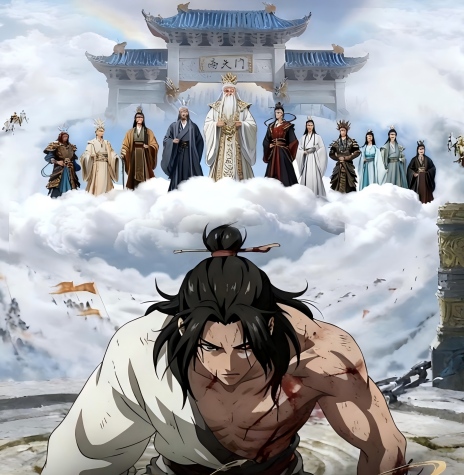
Poster of AI comic drama Zhan Xian Tai Xia Wo Zhen Jing Le Zhu Shen
Platforms and leading tools are also defining their own quality benchmarks. Yuewen launched its "Comic Drama Assistant," a one-stop creation platform that guides creators through built-in review mechanisms and recommendation algorithms. OiiOii, meanwhile, has defined a new "70-point premium" baseline through product design—even non-professional users can consistently produce works that meet or exceed passing standards in cinematography, character consistency, and narrative completeness.
In early 2026, China's National Radio and Television Administration launched a special regulatory campaign targeting the misuse of AI to distort classics, harm minors, or misrepresent historical and cultural narratives. These measures accelerated industry self-cleansing. The once-viral Failed the Gaokao, Tricked Classmates into Enrolling in an Underworld University, which garnered 140 million views, was removed across platforms due to content issues—signaling the end of an era in which sensationalism and vulgarity drove traffic.
Talent Restructuring: Creativity as the Core Competitive Edge
The rapid rise of AI comic dramas has triggered a profound shift in talent structure. In traditional animation, technical roles such as key animators and in-between artists dominated; today, demand has shifted sharply toward creative planning, textual comprehension, and aesthetic judgment.
Data from an animation studio in Hangzhou shows that more than half of its 100-plus animators joined the industry only within the past six months. The company's head explained: "Previously, it took six months to a year of systematic training for a newcomer to independently handle basic animation design. Now, after about a week of AI tool training and creative expression guidance, newcomers can already participate in producing simple comic drama segments."
OiiOii's user base exemplifies this shift. Users do not need to master complex drawing software or prompt engineering; story concepts and aesthetic judgment alone can drive professional workflows. This has attracted many creators from language and literature backgrounds, who excel at world-building and emotional expression, while AI handles visualization. Tools have evolved from technical objects requiring mastery into pure "translators" and "executors" serving creativity.
This trend underpins initiatives like the national "Thousand Creative Realms · New Life for Comic Dramas" competition jointly launched by Shuqi Chinese Webnovel and Yangcheng Evening News, aimed at cultivating digital creators who combine technical literacy with strong content creativity and exploring more diverse themes.
Three Challenges and Future Possibilities
Looking ahead, the AI comic drama industry faces three major challenges: technology, content, and business models.
Technologically, while AI can now generate continuous and fluid motion, it still struggles with precise control of facial expressions and lip-syncing. The more fundamental challenge lies in enabling AI to truly understand and convey complex human emotions—requiring breakthroughs in algorithms, data, and training methods.
In terms of content, homogenization is the most pressing issue. Genres such as fantasy, time travel, rebirth, and post-apocalypse continue to dominate, with repetitive character setups and plot frameworks eroding audience novelty. Real breakthroughs may come from two directions: deeper mining of China's traditional cultural resources, or expansion into genres like science fiction and suspense, which demand higher levels of logic and imagination.
From a business perspective, monetization currently relies mainly on advertising and paid unlocks. Yet the unique value of AI comic dramas lies in their role as the lowest-cost, fastest testing ground in the IP value chain. OiiOii points to another possibility: beyond being a content production tool, its built-in character design, asset libraries, and consistency generation naturally support IP incubation and early visualization. Creators can validate the appeal of characters or stories at minimal cost, laying the groundwork for future development.
An even more imaginative future lies in "stepwise amplification of IP value"—using AI comic dramas to drive traffic to original novels and build fan bases, paving the way for higher-cost adaptations such as full animation, games, live-action series, and merchandise.
On January 20, 2026, Douyin's Ocean Engine announced that daily spending in ByteDance's comic drama segment had reached RMB 30 million. Days earlier, Shuqi Chinese Web novel disclosed investments of over RMB 100 million to comprehensively scale AI comic dramas across the entire pipeline. Behind these figures is a pivotal inflection point: an industry transitioning from quantitative change to qualitative transformation, from efficiency competition to standard definition.
Professional productions by Hangzhou animation studios and individual creations by ordinary college students using OiiOii—once parallel trajectories—are now converging toward the same future under AI empowerment. When technology is no longer scarce, the future of the industry will be decided by those who can tell compelling stories with AI, and by platforms capable of building sustainable ecosystems.
In the past, creating animation was the domain of a select few professionals. Today, with AI tools, countless individuals are becoming the "directors" of their own stories. When technology is no longer scarce, the ultimate determinant of the future will be those who can tell good stories with AI—and the platforms that can sustain them.


